
EWR 2026 Search Firm Writing Benchmark
Search firm writing helps the reader. It rarely makes the case for the firm.
The benchmark scored 161 executive search firms on what they publish and how well it’s written. Across 840 articles, case studies, reports and bios, the average Writing Quality score is 33.5 out of 100.
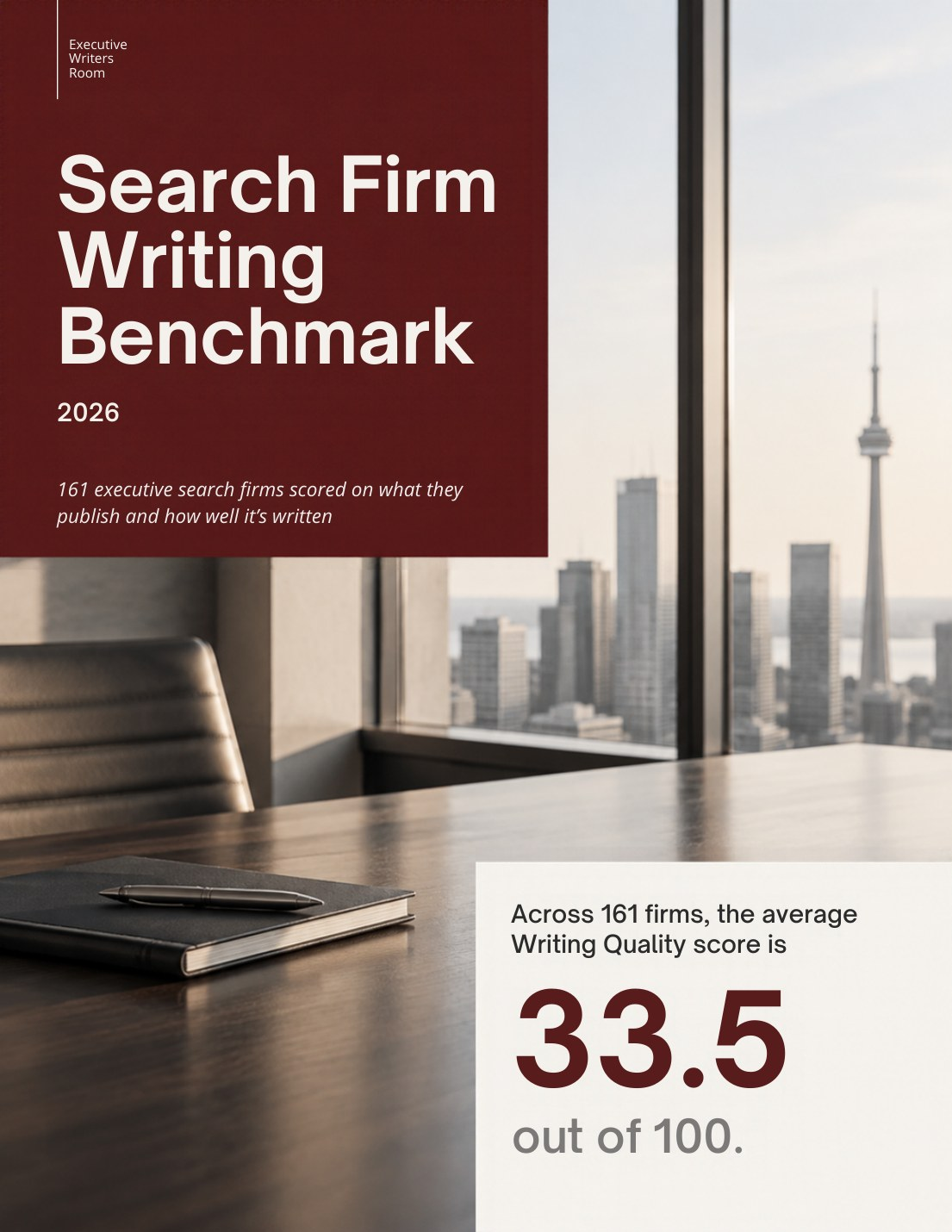
33.5
out of 100 is the average Writing Quality score. No firm scores above 62.
29
of 161 firms publish articles, case studies and reports. Twenty-five publish none of the three.
6
of 125 case studies let a named consultant tell the story of the search.
69%
of the firms’ own pieces (573 of 835) contain a confirmed error, a broken link or a stale time reference.
Source: EWR 2026 Search Firm Writing Benchmark, 161 firms scored.
What the study found
The proof a buyer looks for is the part most firms haven’t written.
Buyers hire a person’s judgment, and a firm’s published writing is where most of them first see it. Here’s what they find.
Most firms leave out the genres that carry most of the score.
105
of 161 firms publish no report built on their own data, and 93 publish no case study of a search.
Articles help the reader, but few make the case for the firm.
8%
of 373 articles invite the reader to talk to the person who wrote them. 90% leave the reader a usable decision tool.
The genres built to prove the work prove the least.
4
of 56 reports have a title that states what the research found. The rest name the subject.
No homepage says something a competitor couldn’t also say.
0
of 161 homepages passed the swap test. Put a rival’s name in the hero and every sentence still holds.
The writing is cleaner than it is persuasive.
Hygiene checks for errors, broken links and template phrasing. Marketing effectiveness checks whether a piece moves a buyer toward the firm.
Average sub-scores out of 100, by genre. Source: EWR 2026 Search Firm Writing Benchmark, 161 firms scored.
Inside the report
What’s in the 37 pages
Each findings chapter names the firms doing it well and ends with one action you can run on your own pieces.
1. Executive summary
Seven findings in two pages.
pg 3
2. How the study was conducted
The inclusion rule, both scoring methods and what the study can’t show.
pg 5
3. What firms publish
Positioning, proof, bylines and recency across 161 sites.
pg 8
4. How well the writing works
Articles, case studies and reports, check by check. Then the style faults most firms share.
pg 14
5. The content maturity gap
Four stages, from minimal evidence to authority. Nine firms reach the top one, and the report names them.
pg 31
6. What to fix first
A 90-day plan. Every step names the finding it answers and a test for done.
pg 34
7. Most firms miss the chance to prove their work
The closing argument, in one page.
pg 37
What to do with it
It ends with a 90-day plan for your own firm.
The quickest gains are in pieces you’ve already published. The largest are in the genres you haven’t written yet. The plan takes them in that order.
Days 1 to 30
Fix the pieces already on your site and set a schedule.
Check every figure, link and date. Rewrite every close around one next step. Put a consultant’s name on every piece.
Days 31 to 60
Write up two searches and start publishing.
Two case studies told by a named consultant, with the method in numbers and an outcome that outlasts the start date.
Days 61 to 90
Build a report and keep publishing.
One report on your own data. It doesn’t need a large survey. Your own searches can supply the numbers.
Method
How the study was run
One rule decided which firms were in.
Executive search firms, retained or hybrid, in North America, the UK, Ireland, Australia or New Zealand, with a technology or private equity and venture capital practice stated on their own site. 161 qualified, and all 161 were scored.
Every firm got two scores.
Content Footprint applies 28 yes-or-no checks, worth 100 points, to the same set of pages at every firm. Writing Quality reads the writing itself: 374 articles, 126 case studies, 56 reports and 284 bios.
Every result has evidence behind it.
Each Writing Quality check is answered met, missed or not applicable, with a verbatim quote from the piece. Every percentage in the report carries its base.
The limits are stated up front.
The study measures published writing, not the quality of a firm’s searches. The method chapter lists what it can’t show, and the text says so wherever a finding turns into an interpretation.
Who ran it. Executive Writers Room writes articles, case studies and reports for executive search firms, in the voice of the partners who did the work. The benchmark is the studio’s own research, led by founder Sue Howard.
See how 161 firms write. Then hold your own pieces up to it.
The full report is FREE – 37 pages, with a 90-day plan at the end.
Your details are used to send you the report. Privacy policy